
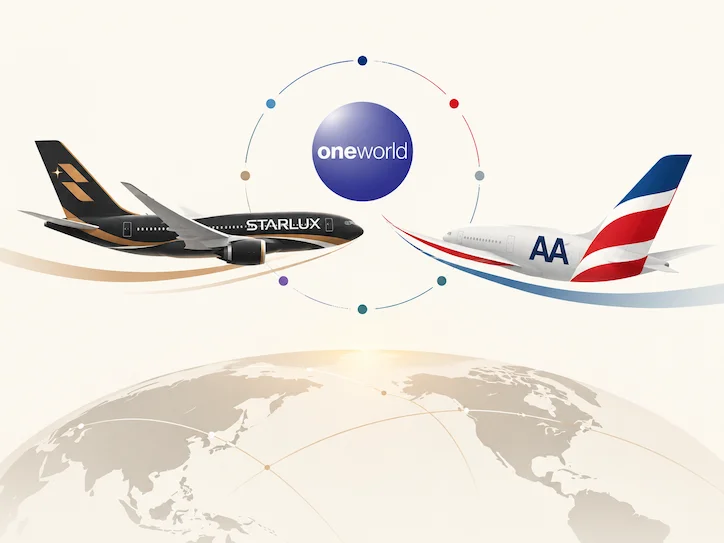
Frequent flyers and airline watchers who hop between mainland China, Taiwan, and the United States just got a genuine piece of news: American Airlines and Starlux Airlines have officially launched a codeshare.
That is more than a smoother itinerary to North America. In frequent-flyer circles it immediately raised two questions: is Starlux any closer to joining Oneworld? And do the miles sitting in our accounts suddenly have somewhere new to go? Here is the substance of the announcement, and why it matters further out.
✈️ The news: what AA and Starlux actually launched
Per the official announcements, codeshare tickets went on sale on September 23. For now the partnership is about connecting the two networks and making it easier to buy a ticket. The highlights:
- Seamless U.S. domestic connections: Starlux’s (JX) code is being placed on more than 20 popular American Airlines domestic destinations, including New York JFK, Miami, Dallas, Chicago, and Boston.
- Transpacific codeshare: American’s (AA) code is going on Starlux’s transpacific flights between Taipei (TPE) and Los Angeles (LAX), Ontario (ONT), San Francisco (SFO), and Seattle (SEA).
- One ticket, bags checked through: You can now book a transpacific plus U.S. domestic connection as a single ticket, with through-checked bags. No more collecting and rechecking luggage on the connection, and a delay on one leg is covered as a connecting itinerary.
- Mileage programs (coming soon): Reciprocal earning and redemption are not live yet. Starlux has said two-way mileage accrual and awards are in development. No launch date has been given.
💡 Frequent-flyer view: what is actually worth watching
The reciprocal loyalty piece has not landed, but the promise is enough to get points collectors excited.
1. A new transpacific sweet spot
If you are sitting on a pile of AA miles, redemptions have been a mixed bag lately. Partner awards on Oneworld still look good on the chart, but Japan Airlines (JAL) has been tightening award space, and Cathay Pacific (CX) often blocks partner airlines.
Starlux is known for genuinely good hardware—especially that fully-flat business class with sliding doors—and for strong catering. If it opens awards to AAdvantage, that takes real pressure off premium-cabin space on China–U.S. and Taiwan–U.S. routes, and it becomes one of the more interesting new homes for AA miles.
2. The first-class question
Alaska Airlines already lets you redeem miles on Starlux, but only up to business class. The scarce first-class seats on Starlux’s A350s have stayed closed to partners.
As the AA partnership deepens, can American’s size pry those first-class awards open? That is the question frequent-flyer circles will be watching over the next few months.
3. Smoother positioning to the West Coast
Even if you ignore miles and just buy cash tickets, this helps students and Chinese-speaking travellers who do not live next to a West Coast gateway. You can book a connecting ticket from somewhere like North Carolina or Ohio, via the West Coast, back to Asia, instead of stitching two separate tickets and eating the risk when something goes wrong.
♟️ How close is Starlux to Oneworld?
A lot of flyers are asking the same thing: Starlux has now gone deep with both Alaska and American. Is this the on-ramp to Oneworld?
Yes. Starlux is playing a long game, and it is playing it deliberately.
Look at Taiwan’s airline market. EVA Air is already a Star Alliance heavyweight. China Airlines sits in SkyTeam. The only alliance left for Starlux to break into is Oneworld.
The obstacle is a large one: Cathay Pacific. As a founding Oneworld member, Cathay has real weight inside the alliance—veto power, even. Taiwan is a critical origin market for Cathay, which relies on Taiwanese passengers connecting over Hong Kong to Europe and North America. Starlux’s upscale product and expanding transpacific flying cut straight into that traffic.
So Starlux’s current move is a smart one: win the big players first, then work inward.
By tying itself tightly to Oneworld’s two largest North American voices—Alaska and American—it is building a shared book of business. Those carriers feed a huge amount of North American traffic into the alliance. Starlux is using that to stack political chips, and maybe to have them lean on or counterbalance Cathay.
Closing
The AA–Starlux codeshare is not just “another way to buy a ticket.” It is a piece of Starlux’s global network, and a real knock on Oneworld’s door. Next up: wait for the AA award chart on Starlux, and see how much more this web can deliver for frequent flyers.
AA miles are worth more now. What should you do?
With Starlux awards expected to open to AAdvantage, AA miles are more worth holding. Start stocking miles, and points that transfer into AA. 🇨🇦 In Canada, that is RBC Avion points. 🇺🇸 In the United States, that is the AA co-branded cards.


Comments
Comments from a new email are reviewed before they appear.