
【November 3, 2026 update】 Harbour Air is running a free giveaway — three winners each receive 100,000 Aeroplan points. Enter in three steps:
- Join Harbour Air Club
- Link your Aeroplan account in your Club profile
- Submit the entry form once (⚠️ one entry per person; duplicate entries void all of them)
Key rules:
- Open only to B.C. residents aged 19 or older
- Deadline: December 14, 2026, at 11:59 p.m. Pacific Time
Also, members who join before the deadline receive a 10% off first-flight coupon for Comfort or Flex base fares (taxes excluded). Book by January 10, 2027, and fly by March 31, 2027.
Winners are drawn at random after the contest ends and notified by email. Points can take up to 12 weeks to post. Contest page and entry: https://harbourair.com/ha-club-100k-giveaway/
The partnership between Air Canada Aeroplan and Harbour Air is now complete on both sides:
- Earning went live on December 10, 2025: book on Harbour Air’s website, add your Aeroplan number to your Harbour Air Club profile, and earn a fixed number of points by fare type on scheduled flights (see the table below).
- Redemptions went live on October 28, 2026: Harbour Air became an Aeroplan Select Partner, with scheduled seaplane flights available from 9,000 points one way plus a $39 partner booking fee. The official booking channels are aircanada.com and the Air Canada app.
- Background: Harbour Air announced on September 15, 2026, that it would acquire Pacific Coastal Airlines. The deal still needs regulatory approval, and the two airlines continue to operate independently for now.
Airline overview
Harbour Air (commonly translated as “港湾航空” in Chinese, IATA code YB) is a British Columbia seaplane airline. It sells most flights through its own channels and has also used Hahn Air Technologies’ X1 code in major GDS distribution systems since 2021, allowing travel agencies to issue tickets. The company started in 1982 with two small seaplanes providing transportation for B.C.’s forestry industry. It now calls itself North America’s largest seaplane airline, with the continent’s largest all-seaplane fleet. It was also the first carbon-neutral airline in North America; every fare has included a carbon offset since 2007.
The company’s Vancouver hubs include Vancouver Harbour Flight Centre at Coal Harbour downtown and the seaplane terminal at Vancouver International Airport’s South Terminal in Richmond (YVR South). The group also includes the Whistler Air and Saltspring Air brands. Harbour Air says it operates up to about 200 scheduled flights a day and carries roughly 500,000 passengers a year. Its current CEO is Bert van der Stege.
The airline has a clear niche: instead of competing with mainline carriers, it provides short-haul “water-to-water” transport between coastal communities. A flight from downtown Vancouver to Victoria’s Inner Harbour takes about 35 minutes, avoiding airport security, terminal transfers, and the hours required for a ferry trip. It is a practical everyday option for B.C. coastal commuters, business travellers, and tourists.
Fleet
The fleet is mainly made up of seaplanes, with a small number of aircraft equipped with wheeled landing gear for airport operations (see below). Harbour Air’s official figure is more than 40 aircraft, led by classic Canadian de Havilland types:
| Aircraft type | Seats (approx.) | Notes |
|---|---|---|
| DHC-2 Beaver | 6 | Legendary bush plane that first flew in 1947; mainly used for short-haul, sightseeing, and charter flights |
| DHC-3 Single Otter | 14 | The largest type in the fleet and the main aircraft on routes such as Vancouver–Victoria |
| DHC-6 Twin Otter | 19 (4 officially confirmed) |
Twin-engine aircraft used on longer routes such as Victoria–Seattle; two have wheeled landing gear for airport routes such as YVR South Terminal–Victoria International Airport (YYJ) |
| Cessna Grand Caravan EX | 9 | Joined the fleet in 2018, is capable of instrument flight, and mainly operates Vancouver–Seattle and Vancouver–Tofino |
The fleet’s most notable development is electrification. On December 10, 2019, Harbour Air and magniX completed the first flight in Richmond of the fully electric eBeaver, the world’s first all-electric commercial aircraft. In April 2024, the company signed a letter of intent to acquire 50 magniX electric motors to support certification and the conversion of its Beaver fleet. Public information in April 2024 cited 78 test flights; by September of the same year, Harbour Air’s official figure had reached 90. Its certification expectation at the time was 2026–2027. As of publication, the company has not announced that electric aircraft have entered passenger service, so the programme is still in development.
Route network
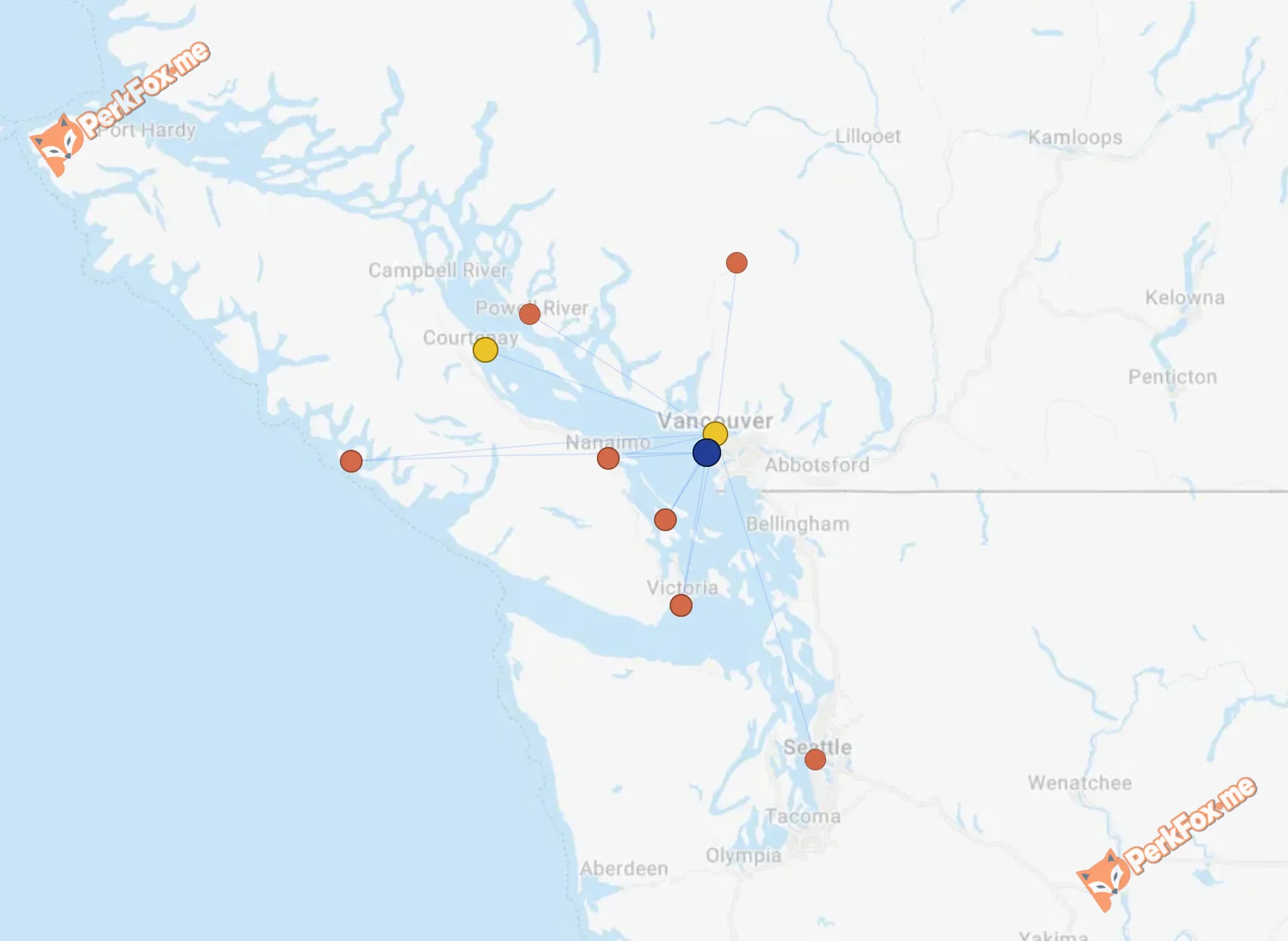
Harbour Air officially serves 13 scheduled destinations, all along the B.C. coast and in the Pacific Northwest of the United States:
Vancouver Harbour (CXH), Vancouver International Airport South Terminal, Victoria (Inner Harbour, YWH), Nanaimo, Salt Spring Island (Ganges Harbour), Sechelt, Powell River, Comox, Campbell River, Tofino, Ucluelet, Whistler (Green Lake), and Seattle (Lake Union).
Here are a few practical points:
- Vancouver has two departure points, so check your booking carefully: Vancouver Harbour is convenient for downtown, the cruise terminal, and Canada Place. YVR South Terminal is better for connecting to a mainline flight at Vancouver International Airport; a shuttle connects it with the main terminal. The ground transfer between the two Vancouver locations takes about 30–45 minutes.
- The network is highly seasonal: Seattle, Whistler, Comox, Powell River, and Sechelt are spring and summer routes. Sechelt has already become summer-only; in 2026, the Vancouver–Sechelt route resumed on June 26. Winter schedules shrink significantly. Campbell River, Ucluelet, and Victoria–Seattle were new routes in 2026, so the network is still expanding.
- Tofino operates year-round, but the aircraft and airport change by season: in summer, the seaplane flies to Tofino Harbour; in winter, a wheeled aircraft flies to Tofino-Long Beach Airport (YAZ), with four weekly flights from October 27, 2025. Similarly, Vancouver–Victoria has both the harbour-to-harbour seaplane and a wheeled service between YVR South Terminal and YYJ. Wheeled flights have higher baggage limits than the seaplane version, so check the departure and arrival points when booking.
- In addition to scheduled flights, the company operates scenic tours and charters. These two types of service are not eligible for Aeroplan redemptions.
Fare structure
Harbour Air sells four fare types. The main differences are baggage allowance and change or cancellation flexibility (the following are the current rules on the official fares page, with amounts in Canadian dollars):
| Light | Value | Comfort | Flex | |
|---|---|---|---|---|
| Baggage allowance (total weight, seaplane / wheeled flight) | 10 / 15 lb | 15 / 30 lb | 25 / 45 lb | 50 / 60 lb |
| Refunds | Non-refundable | Refundable to HA Credit outside 72 hours before departure, with a $50 fee; non-refundable within 72 hours | Refundable to HA Credit outside 24 hours before departure, with a $25 fee; non-refundable within 24 hours | Refundable to the original payment method up to 1 hour before departure |
| Changes (not on the day of departure) | Not permitted | $50 per person, only more than 72 hours before departure | $25 per person, only more than 24 hours before departure | Free |
| Changes (on the day of departure) | Not permitted | $75 per person | $50 per person | Free |
| Priority boarding | No | No | No | Yes |
| Phone or customer-service booking fee | $15 | $15 | $15 | Waived |
Other important rules:
- Baggage is measured by total weight. Every bag is weighed at check-in, and excess weight is charged at $3 per pound. Seaplane cargo holds are small and weight limits are strict, so pack by pounds rather than assuming a piece-based allowance.
- Bookings made through the customer service centre incur a $15 booking fee (per reservation, including tax) when the booking could have been completed online; Flex fares are exempt. The fee can be waived for travellers aged 65 or older, people with disabilities who cannot book independently, unaccompanied minors, travellers who need an unsupported payment method, groups of seven or more, and travel-package bookings. Booking through the website or app is the easiest option.
- Check-in: the airline recommends arriving at the terminal 40 minutes before departure. The check-in cut-off is 15 minutes before departure for Flex and 20 minutes before departure for all other fares.
- If your bags are clearly overweight, members can consider Buy-a-Bag. Value, Comfort, and Flex tickets can add 25 pounds of extra baggage allowance for $45 when booked in advance or $55 at check-in.
- Price example (checked in October 2026): Vancouver Harbour–Victoria is the flagship route. Harbour Air’s Everyday Low Fares start at $99 for a Light ticket when booked at least 45 days in advance. Limited-time sales can be cheaper; a 2026 Thanksgiving promotion offered the same route for $69. Comfort on the same route is usually around $237, with higher prices during peak periods and on peak flights. These are time-specific prices, so check the official website before booking.
Harbour Air’s loyalty programme and prepaid products
Many people do not realise that Harbour Air has a full loyalty programme of its own, and it stacks with Aeroplan:
- Harbour Air Club: a free in-house loyalty programme with Blue, Silver, and Gold tiers. Members earn Club Credits on eligible spending: 5 points per $1 for Blue, 6 for Silver, and 7 for Gold. Silver requires 18,000 Credits or 30 segments in a year, while Gold requires 35,000 Credits or 50 segments. Benefits include excess-baggage waivers (25 pounds for Silver and 50 pounds for Gold), sightseeing vouchers, and, for Gold members, companion tickets and waived change fees. Companion tickets cover the base fare only, with taxes and fees charged separately. The baggage and change-fee waivers do not apply to Commuter Pass or Explorer Pass bookings. The key point: after adding your Aeroplan number, the same ticket can earn both Club Credits and Aeroplan points.
- Commuter Pass: a prepaid pass for frequent commuters. Four routes are available—Vancouver–Victoria, Vancouver–Nanaimo, Vancouver–Salt Spring, and Vancouver–Powell River—with combinations of 10, 20, 40, or 50 one-way Value tickets. The pass includes bonus tickets and has no blackout dates. The guaranteed baggage allowance is 15 pounds, plus another 10 pounds free when capacity allows. Baggage above 25 pounds costs $3 per pound and is also subject to available capacity. Bookings must be made more than 72 hours in advance, and the pass is valid for 12 months.
- There is also a Student Commuter Pass with 10 one-way Vancouver–Victoria tickets, as well as the network-wide unlimited-use Explorer Pass.
- Turbobucks: prepaid flight credit that can be used for Value, Comfort, or Flex fares on any route. The balance never expires, and reloads include a bonus: 5% on $2,000–$4,999, 10% on $5,000–$19,999, and 15% on $20,000 or more. The current status is “existing balances usable, new accounts closed”: the website says new accounts are no longer available, but existing account holders can still reload and redeem normally. The official fares page also lists the rules for older prepaid products such as Prepaid Quick Tickets.
Aeroplan partnership: earning and redeeming points
This is the most important section for points collectors. The partnership has two stages: earning opened on December 10, 2025, and redemptions opened on October 28, 2026.
Earning on cash tickets
Book through Harbour Air’s website or app, add your Aeroplan number to your Harbour Air Club profile in advance, and earn a fixed number of points per segment rather than a distance- or fare-based percentage:
| Fare type | Aeroplan points per segment |
|---|---|
| Flex | 200 |
| Comfort | 150 |
| Value | 100 |
| Light | None |
Light is a completely bare-bones fare: it includes only 10 pounds of baggage and earns no Aeroplan points.
There are two easy-to-miss rules:
- There is a 24-hour retroactive-registration window: you must first join Harbour Air Club and add your Aeroplan number to your member profile. The Club terms allow you to join and register the number within 24 hours after completing the flight, and the Aeroplan points and Club Credits for that segment can still be credited. If you forget to add your number when booking, do not wait past this window.
- Not every paid ticket earns points: third-party leisure-travel-agent bookings, industry-discount tickets, standby and employee tickets, tickets paid with promotional vouchers or High Flyer Rewards, and free or non-revenue tickets are excluded. Commuter Pass and Explorer Pass bookings earn at the Value rate.
Redeeming points (award tickets, launched October 28, 2026)
- Positioning: Harbour Air is a Select Partner. Under the Air Canada and Harbour Air launch terms, it is included with Calm Air, Canadian North, and PAL Airlines in the “Air Canada and select partners” redemption table. Pricing is dynamic and changes with the route and demand. The table’s general indicator for economy awards within North America and 0–500 miles is 6,000 points, but Harbour Air’s actual starting price is 9,000 points, so do not assume the generic starting rate applies.
- Starting price: from 9,000 points one way. This matches both the official wording and the website’s observed pricing; Vancouver Harbour–Victoria Harbour is available at the 9,000-point level. Rewards Canada observed another Latitude-level price of 14,000 points on launch day. This is an October 2026 price snapshot, and dynamic pricing can change at any time.
- Fees: taxes and a fixed $39 partner booking fee apply. Air Canada’s Flight Reward Policy expressly applies this fee to award tickets operated by a non-Air Canada carrier. The website showed Vancouver–Victoria at 9,000 points + $39, with almost no other taxes on the route itself.
- Baggage: award tickets include 25 pounds of baggage per person, equivalent to the Comfort allowance and more generous than the Light or Value cash fares.
- Booking channels: awards can be booked only at aircanada.com or through the Air Canada app. When searching, select “all airports” for the departure city so that both Air Canada mainline flights and Harbour Air seaplanes appear. Harbour Air’s own channels do not sell award tickets.
- Hard restriction: Air Canada’s policy expressly says that Harbour Air flights cannot be combined with flights operated by any other airline in the same award itinerary. This is an initial-launch restriction and the wording suggests it may be temporary. Sightseeing tours and charters are not eligible for redemption.
Is it worth redeeming? A simple dividing line
Using Vancouver–Victoria at 9,000 points + $39 as an example, we can work out the value per point:
- Compared with a Light cash fare of about $99: ($99 − $39) ÷ 9,000 ≈ 0.66¢ per point—far below the usual value of Aeroplan points. Buying the Light fare with cash is better.
- Compared with a Comfort cash fare of about $237: ($237 − $39) ÷ 9,000 ≈ 2.2¢ per point—quite good, especially when you need 25 pounds of baggage or Light has sold out or become expensive for your dates. The award ticket’s relative value can rise further in those cases.
The right way to use this redemption option is not “redeem whenever you have points.” It makes sense when you would otherwise buy Comfort, or when cash fares rise during a busy period. It also gives Aeroplan members who regularly travel to Vancouver Island and coastal communities a useful outlet for their points: short, frequent routes where cash fares are not always cheap now have another way to pay.
Standout features
- Downtown to downtown: Vancouver’s Coal Harbour terminal is within walking distance of Canada Place and the downtown hotel district, while Victoria flights arrive at the Inner Harbour. Both ends avoid airport transfers, which is the core advantage over a ferry or an “airport plus ground transfer” combination.
- Carbon neutral: Harbour Air has been North America’s first carbon-neutral airline since 2007, with carbon offsets included in fares. If the electric eBeaver completes certification, the company could also become a pioneer in electric commercial aviation.
- Weather sensitivity: Seaplanes are more affected by visibility and wind or waves than mainline flights. Winter delays and cancellations are relatively more common, so do not schedule a tight itinerary. Leave plenty of buffer before an international connection.
Relationship with Pacific Coastal Airlines: latest update
- September 15, 2026: Harbour Air announced its acquisition of Pacific Coastal Airlines (IATA code 8P, a wheeled regional airline based at YVR South Terminal with 19 inland and coastal destinations in B.C.). The combined group would have 59 aircraft, serve 25 communities, and employ more than 900 people. The two airlines will retain their own brands, operating licences, and teams. The acquisition announcement also previewed a unified loyalty programme for the group and plans to develop Vancouver International Airport as a major hub.
- As of October 28, 2026: the deal is still waiting for regulatory approval, no closing date has been announced, and the two airlines continue to operate independently. There has been no further update through official channels.
- Keep the Air Canada partnership distinction clear: Pacific Coastal’s September 2026 agreement with Air Canada is an interline agreement—single-ticket cash itineraries, through-checked bags, and sales through aircanada.com and other channels. It is completely separate from the Aeroplan award partnership discussed here. 8P flights currently cannot be booked with Aeroplan points; only Harbour Air’s own seaplane flights are eligible. If the acquisition closes, whether Pacific Coastal joins Aeroplan earning or redemptions will be the next major development to watch.
Official links
- Harbour Air website: https://harbourair.com
- Fares and baggage rules: https://harbourair.com/fares/
- Harbour Air Club: https://harbourair.com/ha-club/
- Aeroplan booking portal: https://www.aircanada.com


Comments
Comments from a new email are reviewed before they appear.