

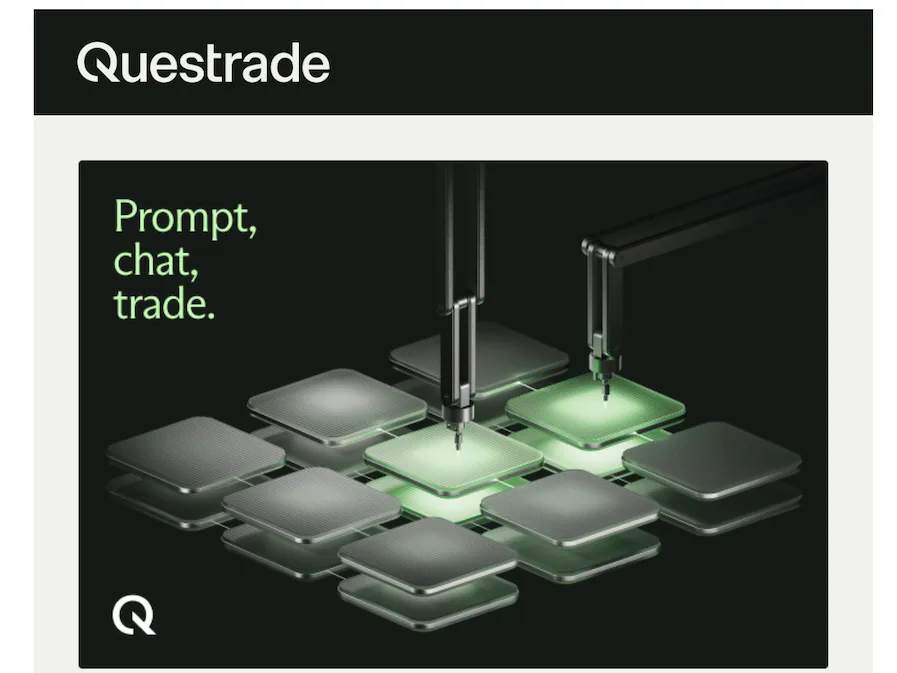
If you are a Questrade client (the Canadian brokerage) and your account has enough assets or you have completed accredited-investor verification, you may recently have received a fairly flashy email: Questrade has opened Pre-IPO (pre-listing private equity) investing, and the first names on the list are two unlisted unicorns, Stripe and Polymarket.
Is this just the usual IPO lottery, or a genuinely new Questrade product? And what does it mean for everyday retail investors? This article walks through the whole picture.
The new Pre-IPO feature
The email is really selling Questrade’s newly launched Private Markets / Pre-IPO service: access to private-company equity before a public listing.
- First-round names:
- Stripe: a major internet payments-infrastructure company, backed by Sequoia Capital and Andreessen Horowitz (a16z).
- Polymarket: a global decentralized prediction-market platform, backed by Founders Fund and Vitalik Buterin.
- Rules and timing:
- Limited allocations, first come, first served: Polymarket closes on August 18; Stripe closes on September 3 (or earlier if it sells out).
- Member priority: Questrade Plus subscribers get first access.
- Minimum: the typical starting ticket is $5,000 USD.
How Pre-IPO differs from a traditional IPO
This is not a traditional IPO subscription. It is a new product line. Plenty of investors mix up Pre-IPO (pre-listing private placement) and IPO (initial public offering). They are not the same thing:
| Dimension | Pre-IPO investing (this new feature) | Traditional IPO subscription (IPO Centre) |
|---|---|---|
| Company status | The company is still private / unlisted. | The company has filed a prospectus and is about to go public. |
| Who can participate | Accredited investors only. | Everyday retail investors can usually apply. |
| Account type | Personal self-directed non-registered accounts (Cash / Margin) only. | You can usually use registered accounts such as a TFSA or RRSP. |
| Liquidity | Very low. Capital is locked for a long time, until an IPO or acquisition. | You can trade on the public market on listing day or after the lock-up. |
| Risk and valuation | Valuation is opaque, and there is no guarantee the company will list in the near term. | The price is set in the prospectus, with relatively strict regulatory review. |
“Accredited investor”
Questrade’s Private Markets (including Pre-IPO) eligibility check looks roughly like this:
- You need a Questrade personal self-directed investing account.
- Canadian residents only, excluding Quebec; US persons cannot participate.
- You must fit one of these two categories:
| Status | Income test (last two years, and expected again this year) | Or net financial assets |
|---|---|---|
| Accredited investor | Pre-tax income over $200,000; or over $300,000 combined with a spouse |
Over $1,000,000, after related liabilities |
| Eligible investor | Pre-tax income over $75,000; or over $125,000 combined with a spouse |
Over $400,000, after related liabilities |
Documents you will need:
- Applying on income: this year’s most recent pay stub (with year-to-date income) plus T4s or notices of assessment (NOA) for the last two years.
- Applying on assets: the latest bank or brokerage statement, clearly showing your name and balance.
- Applying jointly with a spouse: first update marital status and spouse details in your profile, then submit matching documents for both of you.
A few extra notes:
- If your total assets at Questrade are already $1,000,000+, you are usually treated as accredited automatically.
- Verification is valid for 12 months; review typically takes up to 5 business days, with notice by email.
- Eligible investors have a $30,000 cap on exemption-market purchases over the past 12 months, across all products.
- Not every deal is open to eligible investors; some Pre-IPO offerings may be accredited-only.
Under Canadian securities rules (NI 45-106), Pre-IPO sits in a high-risk private-placement category, so accredited-investor status is required.
How Canada’s main brokerages compare
| Brokerage | Matching feature / service | What you actually get |
|---|---|---|
| Questrade | Private Markets / Pre-IPO | The differentiated pitch: qualified Canadian retail clients can buy unlisted unicorn equity such as Stripe, which is unusual at a retail brokerage. |
| Wealthsimple | IPO Access | Focused on the public-listing stage (IPO issue price) and trying to secure an allocation for everyday retail clients, including TFSA/RRSP accounts. This is not true primary-market Pre-IPO. |
| TD Direct Investing | New Issues Centre | A traditional new-issue / secondary platform, mainly for mature companies listing or doing follow-on offerings. It does not offer unlisted unicorn stakes. |
The fine print and risks of Pre-IPO investing
Getting in early on the next internet giant sounds tempting, but stay clear-eyed about the details:
- Holding structure (SPV / fund): what you buy at Questrade is usually not Stripe stock directly. You are buying units of a Pre-IPO fund or special-purpose vehicle (SPV) that holds that name.
- Lock-up period: even if the company later IPOs, Pre-IPO investors typically face a 90- to 180-day lock-up. After it lifts, public shares or cash usually settle into your account within 10–15 business days.
- Fees and valuation: besides trading commissions, check whether the SPV has extra management fees, performance fees, or transfer restrictions.
- Tax treatment: because this cannot go in a TFSA or RRSP, any later capital gains have to be reported in your personal non-registered account.
Takeaway
Questrade’s Pre-IPO feature does punch a hole in the old monopoly that institutions and ultra-high-net-worth clients had on top unicorn private-market deals. If you already qualify as an accredited / eligible investor, can live with high risk and high return, and do not need the money soon, this is a fairly scarce access point.
For most everyday investors, though, the accreditation bar, the account-type limits, and the poor liquidity mean this is more of a showcase of what Questrade can offer than a product you will actually use. Weigh your own risk tolerance before you put money in.
Keywords: Questrade, Accredited investor, Pre-IPO
Further reading

Comments
Comments from a new email are reviewed before they appear.