
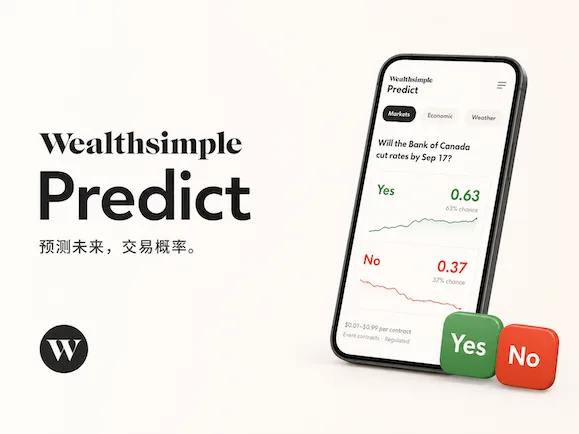
Canadian fintech Wealthsimple recently launched a new service that is both controversial and genuinely new: Wealthsimple Predict. It is not stock trading, and it is not options, futures, or crypto. It is a prediction market — sometimes called an event-contract market — where you buy and sell around the outcome of a real-world event.
In plain terms, you pick Yes or No on a future event and put real money behind that view. For example:
- Will the Bank of Canada cut rates by a given date?
- Will Canadian inflation print above a given level?
- Will gold or crude oil reach a stated price?
- Will rainfall in a city exceed a given amount?
- Will a company’s reported results hit a stated target?
If you are right, the contract settles at USD 1. If you are wrong, it settles at 0.
So how does the product actually work? How is it different from gambling, options, and futures? Can you really make money by predicting? And what should Canadian users watch for on regulation and tax? This article walks through Wealthsimple Predict.
What a prediction market is
A prediction market turns a future event into a tradable financial contract. Each contract is usually a Yes/No question that can be checked objectively, such as:
Will the Bank of Canada cut rates at the next decision?
You can buy:
- Yes contracts: you think the event will happen;
- No contracts: you think it will not.
Prices usually sit between USD 0.01 and 0.99. When the event is resolved, the winning side settles at USD 1 per contract and the losing side settles at USD 0.
Example: suppose the Yes contract on “the Bank of Canada will cut rates next month” is trading at USD 0.70. You spend USD 70 on 100 contracts.
If the Bank does cut:
- 100 contracts settle at USD 100;
- your gross profit is USD 30;
- fees still come out of that.
If it does not cut:
- the contracts settle at 0;
- you lose the USD 70 you put in.
Predict does not offer margin or leverage. You can only trade with cash already in the account. If you simply buy a contract, your maximum loss is usually the amount you paid.
The contract price is the market’s implied probability
The most important thing to understand is that the price is not just a price. It is also an implied market probability. A Yes contract at USD 0.60 means participants as a group currently think the event has about a 60% chance of happening.
Wealthsimple does not set that price. It moves as people buy and sell, as supply and demand shift, and as new information arrives. More Yes buying usually pushes Yes higher; more people betting it will not happen can push No higher. In that sense, a prediction market is a live “crowd probability estimator.”
Stock markets mash investors’ views of a company into a share price. Prediction markets mash views of an event’s odds into a contract price.
You do not have to hold to settlement
Predict contracts have a clear settlement date, but you do not have to wait for the event. If the market is still open and there is enough liquidity, you can sell before settlement. For example:
- you buy Yes at USD 0.40;
- new economic data lands and the market thinks the event is much more likely;
- Yes rises to USD 0.68;
- you sell early and keep USD 0.28 per contract.
If new information goes against you, you can also sell early to cap the loss.
Wealthsimple says Predict is meant to trade around the clock, 7 days a week, except for planned exchange maintenance from 3:00 a.m. to 5:00 a.m. Eastern every Thursday. The underlying prediction-market exchange is Kalshi, a U.S.-regulated venue. Whether you can actually exit still depends on liquidity. Thin contracts can have wide spreads, slow fills, or no clean exit at your price.
What Wealthsimple Predict currently lists
Canada still keeps a tight lid on event contracts. Wealthsimple Predict currently offers three buckets:
- Financial indicators, including: stock indexes; gold, crude oil, and other asset prices; company earnings and related metrics; other permitted market data.
- Economic data, including: Bank of Canada rate decisions; inflation; employment; growth measures; other objectively verifiable macro data.
- Climate and weather, including: whether temperature exceeds a level; rainfall; other climate measures that can be confirmed from a named data source.
Wealthsimple says Predict lists thousands of contracts across those three buckets.
Canada has not approved sports, political elections, or entertainment events. The Canadian version of Predict will not let you trade a presidential race, a pro sports match, or an awards show the way some U.S. prediction markets do. Canada also requires listed contracts to meet related tenor rules. Wealthsimple says it reviews new Kalshi contracts every day against Canadian rules, banned categories, and expiry limits.
A closer look at Predict
It helps to compare prediction markets with markets you already know.
How Predict differs from gambling
Wealthsimple Predict offers a regulated event-derivative contract, not a traditional betting product. Wealthsimple Investments Inc. is an investment dealer regulated by CIRO, Canada’s investment regulator. Predict contracts sit under the matching compliance, risk-disclosure, market-surveillance, and investor-protection rules for derivatives. Wealthsimple says it is one of only two brokers currently allowed to offer this product in Canada.
Regulation does not mean the product is low risk. Event contracts are still highly speculative:
- gains mostly come from other traders’ losses;
- a wrong call can wipe out the full stake;
- the contract itself does not throw off profits, dividends, or long-term business value the way a stock can;
- prices can move on mood, liquidity, and short-term news;
- some participants may have more information or better models than a typical user.
Wealthsimple itself says prediction markets are not for everyone, and you should only put in money you can afford to lose in full. A cleaner way to think about it:
Predict is a regulated event-speculation tool. “Regulated” does not mean “a long-term investment,” and it does not mean you are more likely to make money.
The real trading goal is not “guessing right.” It is finding a mispriced probability.
Plenty of newcomers think they make money if they call the final outcome. That is incomplete. What you actually need to decide is:
Is the implied probability in the current price far enough from the true odds?
A high probability is not the same as a high-value trade, and being right is not the same as making a good trade.
The edge sits in the gap between the market price and a reasonable probability estimate.
How do you work out expected value on a prediction contract?
A simplified formula:
Expected value per contract = your estimated probability of the event × USD 1
Then compare that expected value with the purchase price. Positive expected value does not mean this one trade will pay. Even if the true odds are 60%, there is still a 40% chance it does not happen. A single trade can still go to zero. Positive expected value means that if your method is sound, you trade often enough, and fees and spreads stay under control, the long-run math can lean your way.
How prediction markets differ from futures
Both products let you express a view of the future. The structures are different.
| Comparison | Prediction market | Futures |
|---|---|---|
| What you trade | Whether an event happens | The future price of an asset |
| Outcome | Yes or No | P&L moves continuously with price |
| Final settlement | Right side usually USD 1, wrong side 0 | Settled against the underlying price |
| Margin | Wealthsimple Predict does not offer it | Usually required |
| Leverage | None | Usually leveraged |
| Maximum loss | Buyers are usually limited to the amount paid | Levered losses can grow quickly |
| Traditional use | Probability trading, event hedges | Price lock-in, commodity and financial hedges |
For example:
- “Will the Bank of Canada cut rates before September?” is a prediction contract.
- “Buy or sell crude oil for future delivery at a stated price” is a futures contract.
One original job of futures was helping farmers, producers, and companies lock in a future price. Because futures usually use margin and leverage, an adverse move can trigger a margin call. That risk profile is more complicated than simply buying a prediction contract.
How prediction markets differ from options
Both have an expiry, and both can lose the full amount you paid to buy. They still trade different things.
| Comparison | Prediction market | Options |
|---|---|---|
| Underlying | A real-world event | A stock, ETF, index, or commodity |
| Contract form | Yes or No | Call or put |
| Pricing drivers | Supply, demand, and market probability | Underlying price, strike, volatility, time, and more |
| Payoff | Binary settlement | Moves with the underlying |
| Complexity | Relatively direct | Involves delta, theta, vega, and similar |
| Maximum loss | Amount paid | Buyers are usually limited to the premium; sellers can face much larger risk |
For example:
- buying a call on a stock is a bet that the share price rises versus the strike;
- buying Yes on “will this company’s next-quarter earnings beat a stated number?” is a bet on a specific event.
Option prices move with the underlying, strike, remaining time, implied volatility, and rates. A prediction contract is closer to a direct price on a single event probability. Exchange-traded options are also not the same thing as “binary options,” which are a different, tightly regulated, and widely criticised product.
Prediction markets can hedge risk
Predict does not have to be pure speculation. In some cases you can use an event contract to hedge a specific risk in real life or in a portfolio.
For example:
- a floating-rate borrower worried about higher rates;
- an aviation or transport investor worried about higher oil;
- a restaurant operator worried that rain will keep the patio empty;
- a portfolio that is especially sensitive to high inflation.
In theory you buy the contract that pays if the bad outcome happens. If it does, the contract gain can offset part of the real-world hit. If it does not, the contract cost is more like an insurance premium.
Why prediction markets misprice events
In theory, a market gathers a lot of participants’ information. Prices are still not always accurate. Common reasons include:
- New information is not fully digested yet: right after economic data, a central-bank speech, or a forecast, prices may take time to adjust.
- Too much mood: a crowd can pile into one side because of a headline, a wish, or a hot take, and the price drifts off a reasonable probability.
- Thin liquidity: on quieter contracts, a small order can move the price a lot.
- Cognitive bias: people overweight recent events, familiar events, or outcomes they want.
- Misreading the settlement rules: two contracts that look similar may use different data sources, definitions, cut-off times, or settlement conditions.
Thinking the market might be wrong is not the same as knowing you are more accurate. A price that looks “obviously off” may already include information you have not seen.
What an exit-liquidity trap is
Exit liquidity is the money that lets someone else get out. After a contract rips higher on a hot news story, newcomers may chase because the price keeps rising. Early buyers may be selling into that new money.
For example:
- Yes runs from USD 0.30 to 0.80;
- you chase the trend;
- USD 0.80 already implies an 80% probability;
- even if the event still happens, only USD 0.20 of upside is left;
- if expectations slip a little, the price can drop fast.
So do not only ask:
How much has this contract already rallied?
Ask:
Is the probability in the current price still reasonable?
Watch volume, bid-ask spread, market depth, whether the move looks like a short squeeze of attention, and whether you are the person providing the exit for someone else’s position.
The mistakes newcomers make most often
-
Treating a wish as a probability
Wanting a rate cut does not make a cut more likely.
-
Thinking a high win rate is automatically worth buying
A contract at USD 0.98 may win often, but the most you can make is USD 0.02, and you can still lose the full USD 0.98.
-
Skipping the settlement rules
Confirm: which official source is used; the exact release time; whether the first print or a revision counts; whether a boundary value is included; how time zones are handled; how special events are treated.
-
Ignoring trading fees and FX costs
Predict contracts are priced in U.S. dollars. Canadian users also need to count: contract trading fees; CAD-to-USD conversion costs; bid-ask spreads; the drag from frequent trading.
-
Ignoring liquidity
The price on screen is not a promise that you can buy or sell size at that price.
-
Sizing too large
Even a high-conviction view is still a probability, not a sure thing.
-
Chasing every headline
Fast in-and-out trading can let fees, spreads, and emotional decisions eat any edge.
Risk-management rules for Wealthsimple Predict
-
Keep each position small
Do not dump a large stake into something you think is “almost certain.”
-
Spread event risk
Do not park most of your money in highly related contracts. Several contracts around inflation, rate cuts, and bond prices can all move on the same data print.
-
Leave room for error in your own probability
If the market is 55% and you think 57%, two percentage points may not cover analysis error, fees, and spread. An edge only matters when the gap is large enough.
-
Set an exit before you enter
Before you buy, decide: what new information would kill the original view; at what price the edge is gone; how much loss you can take; whether you plan to hold to settlement.
-
Do not judge a strategy by one win or loss
A 70% contract can still lose. Look at the long-run record, whether your probabilities are calibrated, and results after costs.
Taxes on Wealthsimple Predict profits
This part matters for Canadian users. As of Wealthsimple’s July 2026 materials, the CRA had not issued a dedicated, clear classification for prediction-market profits. Wealthsimple’s view is that these gains are likely taxable, but whether they are capital gains or business income depends on how you actually trade.
More likely capital gains if:
- you trade occasionally;
- you do not trade often;
- you hold relatively longer;
- there is no systematic, high-frequency profit-seeking;
- the activity looks closer to ordinary investing.
Under current capital-gains rules, 50% of net capital gains is included in taxable income.
More likely business income if:
- you trade frequently and regularly;
- holding periods are very short;
- you use a systematic strategy;
- you spend a lot of time researching;
- you have relevant expertise;
- you treat trading income as a main or extra income source.
Business income is generally fully included, though eligible related expenses may be deductible. The CRA does not decide on one factor, and it has not published a magic number of trades that automatically makes something business income. Frequency, intent, experience, strategy, and overall behaviour all count.
Keep records that include at least:
- buy and sell dates for each contract;
- contract name and quantity;
- purchase cost;
- sale or settlement proceeds;
- platform fees;
- USD/CAD exchange rates;
- monthly statements;
- deposits and withdrawals;
- your strategy and research notes.
Wealthsimple’s tax article suggests keeping this for at least six years. Because Predict contracts are in U.S. dollars, Canadian residents usually also convert amounts to CAD for filing. Exchange-rate moves on different dates will change the CAD result.
Pros and cons (risks) of Wealthsimple Predict
Pros:
- Easy structure: Yes/No is more intuitive than options or futures.
- Maximum loss is known up front: with no leverage, buying a contract usually risks only the amount paid.
- You can trade a macro view: if you follow the Bank of Canada, inflation, jobs, gold, oil, or weather, you can turn that view into a position.
- You can exit early: you do not have to hold to final settlement.
- A local, compliant channel: Canadians previously had a hard time accessing prediction markets through a locally regulated broker. Predict is a CIRO-regulated on-ramp.
- Useful as information: even if you never trade, contract prices show live market odds on rates, inflation, asset prices, and climate events.
Cons and risks:
- Still high-risk speculation: a wrong contract can go to zero and has none of the long-term asset value of stocks or bonds.
- Limited Canadian categories: no politics, sports, or entertainment, so the menu is much thinner than some U.S. platforms.
- USD pricing: Canadian users have to think about FX conversion and currency swings.
- Fees can eat small edges: especially when the contract is already expensive and little upside remains, fees and spreads matter more.
- Liquidity varies: quieter events may be hard to exit at a fair price.
- Market odds are not always accurate: thin participation, incomplete information, or excess mood can distort prices.
- Tax treatment is not fully settled: the CRA has not issued a dedicated prediction-market rule, so you need your own records and a view on income type.
- Easy to overtrade: simple Yes/No buttons, 24-hour access, and short settlement cycles can make frequent trading feel like research or investing.
Who Wealthsimple Predict is for
A better fit if you:
- already follow the Bank of Canada, inflation, and economic data;
- can estimate probabilities yourself instead of trading off headlines;
- understand expected value, position sizing, and liquidity risk;
- want to try event contracts with small amounts;
- have a specific risk you want to hedge in part with an event contract.
A poor fit if you:
- treat it as a stable savings product;
- want to get rich quickly;
- chase rallies and dump on dips, or bet constantly;
- cannot afford to lose the full stake;
- will not read settlement details or keep tax records;
- do not have an emergency fund, or still carry high-interest debt.
My take: a trading tool, not an investment product
The interface and Yes/No structure look simple. Doing prediction-market trading well is not. You need:
- information filtering;
- probability thinking;
- a sense of how the market is priced;
- a feel for fees and liquidity;
- strict position sizing;
- patience with settlement rules;
- complete tax records.
For long-term wealth, Predict is a weak substitute for a diversified mix of stock ETFs, bonds, and a long-horizon portfolio. Stocks are ownership. Bonds are a claim on cash flow. A prediction contract is only a short-dated right to a specific event’s settlement. When the event ends, the contract disappears.
So I see Wealthsimple Predict as:
a small-size event-trading tool, a probability dashboard, or a hedge for a specific risk — not the core of a household’s long-term allocation.
For most people, the most useful part may not even be placing a bet. It is watching how prices move after a central-bank speech, a data print, or breaking news. Prediction markets give you an interesting lens:
News tells you what happened. A prediction market tells you what traders think the odds of the next thing are.
Takeaway
Wealthsimple Predict is one of the earlier regulated prediction-market products available to Canadians. You buy Yes or No contracts around financial markets, economic data, and climate events:
- prices usually sit between USD 0.01 and 0.99;
- the price roughly reflects implied market probability;
- a correct call settles at USD 1 per contract;
- a wrong call settles at 0;
- you can sell before the event;
- there is no margin or leverage;
- trading happens in a separate Wealthsimple Predict app;
- Kalshi supplies the underlying event-contract market;
- Canada currently does not list political or sports contracts.
The buttons are simpler than options or futures. The risk is not low.
The hard part is not tapping Yes or No. It is deciding:
- What probability the market is implying now;
- Whether you have better information or analysis;
- Whether the probability gap covers error, fees, and liquidity risk;
- Whether you can take a full loss if you are wrong.
For most people, the sensible approach is a small trial of a new trading tool, not a large bet on something that looks “certain.” The useful lesson from prediction markets is not how to guess the future. It is how to think about probability, price, and uncertainty.
Further reading:



Comments
Comments from a new email are reviewed before they appear.