
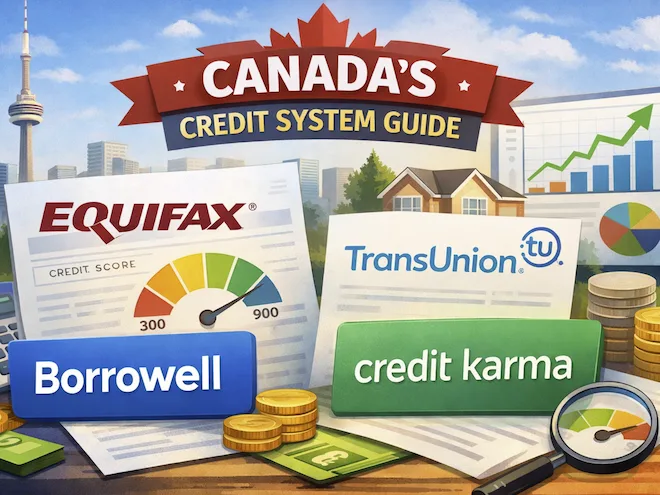
【September 8, 2026 update】 The free credit-score platform Borrowell is running a limited-time promotion: apply for a credit card through Borrowell before October 31 and get an extra $100. Each person can receive up to two $100 rewards.
Some premium and everyday-must cards are on this promo list, and the $100 cash back is higher than other rebate platforms—for example RBC Avion Visa Infinite.
If you live in Canada, one thing matters more than a lot of people expect: your credit score
Credit history comes up when you apply for a credit card, take out a loan, rent an apartment, and even for some jobs. This article walks through the whole picture in one place:
- How Canada’s credit system works
- What the two credit bureaus are
- What to watch in day-to-day use
- How to check your credit file for free
1. How Does Canada’s Credit System Work?
At its core, Canada’s credit system is:
Your financial behaviour is recorded → credit bureaus collect it → it becomes a credit score
That behaviour includes:
- Whether you pay your credit cards on time
- Whether any loans have gone past due
- How much of your available credit you use
- How often you apply for new credit
Those inputs become a score (usually 300–900).
2. The Two Credit Bureaus: Equifax and TransUnion
Canada has only two real underlying data sources:
1) Equifax
- Closer to the traditional bank system
- Many banks (such as TD and Scotia) use it more often
- Updates a little more slowly
2) TransUnion
- Data updates faster
- More internet-based products use it
- RBC, CIBC, and Amex commonly use it
⚠️ Keep this in mind: Equifax ≠ TransUnion. They are two independent databases:
- The data is not always the same
- The scores can differ
Which Bureau Do Canadian Lenders Usually Check?
The table below was produced by a large language model and may not be 100% accurate. Reader DPs are welcome.
| Bank / issuer | Bureau usually checked | Consistency | Notes (these matter) |
|---|---|---|---|
| RBC | TransUnion | Medium | Occasionally checks Equifax |
| TD | Equifax | Medium | Mortgages are almost always Equifax |
| BMO | Dual check (EQ + TU) | Low | The easiest place to get two hard pulls |
| Scotiabank | Dual check (EQ + TU) | Low | The Amex lineup can also dual-check |
| CIBC | TransUnion (recent trend) | Higher | A clear shift to TU from 2024 onward |
| Simplii (CIBC) | TransUnion | High | Generally follows CIBC |
| Tangerine | Mixed | Low | The same person can see different bureaus at different times |
| MBNA | TransUnion | Very high | The most consistent TU card issuer |
| Capital One Canada | TransUnion | Very high | Common for subprime / rebuild |
| PC Financial | TransUnion | Very high | Loblaw family |
| American Express Canada | In-house + (EQ/TU) | Medium | Not always a hard pull |
| HSBC Canada (historical) | Equifax | Medium | Now part of RBC (for reference only) |
| Desjardins | Equifax | Medium | Common in Quebec |
| Credit unions | Equifax | Medium | Depends on the region |
3. How Is Your Credit Score Calculated?
The main factors that move your score:
- Payment history (the most important). On-time vs late; one missed payment can hurt a lot
- Credit utilization. Aim for 10% (excellent) or 30% (acceptable)
- Length of credit history
- Number of inquiries (hard inquiries)
- Credit mix. Cards plus loans look better than one type alone
Those factors point to a few habits worth building. Watch these ⚠️:
- Never pay late
- Do not max out your cards
- Do not apply for cards constantly
- Check both credit files. A bank usually pulls only one
- Dispute errors yourself. The two bureaus do not sync automatically, so you have to file with both.
4. How to Check Your Credit Score for Free: Borrowell and Credit Karma
Canada’s two main free tools are Borrowell and Credit Karma. Borrowell is a Canadian fintech company that partners with Equifax, uses bank-grade encryption, and has more than 3 million users.
Some banks also run their own scoring models and show you an internal score. The comparison is in the table below:
| Dimension | Borrowell | Credit Karma | Bank credit score |
|---|---|---|---|
| Data source | Equifax | TransUnion | Not fixed |
| Free | ✔ | ✔ | ✔ |
| Update frequency | Weekly | More frequent | Monthly or slower |
| Data completeness | Half the picture | Half the picture | Opaque |
| Alerts | Yes | Stronger | Almost none |
| UI | Average | Best | Weak |
| Product recommendations | Yes (commission) | Stronger (commission) | Almost none |
| Effect on your score | None | None | None |
| Practical value | ⭐⭐⭐⭐ | ⭐⭐⭐⭐⭐ | ⭐⭐ |
Do not get too anxious about these free platforms. They make money by recommending other products. Do not take those recommendations at face value; make your own call. What you give up is some personal information—name, address, phone number, and similar details—in exchange for free access to your credit file.
➡️ ➡️ Borrowell referral signup link 🔗, Borrowell website https://borrowell.com/
➡️ ➡️ Credit Karma website https://www.creditkarma.ca/
A useful way to picture the stack:
- Equifax / TransUnion = the raw data
- Credit Karma / Borrowell = the UI and analysis layer
5. Advice for Newcomers
If you just arrived in Canada, start with these three things:
- Pay your credit card in full every month
- Keep utilization between 10% and 30%
- Monitor with both Borrowell and Credit Karma
Comments
Comments from a new email are reviewed before they appear.