
Canadian readers got the email too. Have a laugh. This one is strictly for looking.
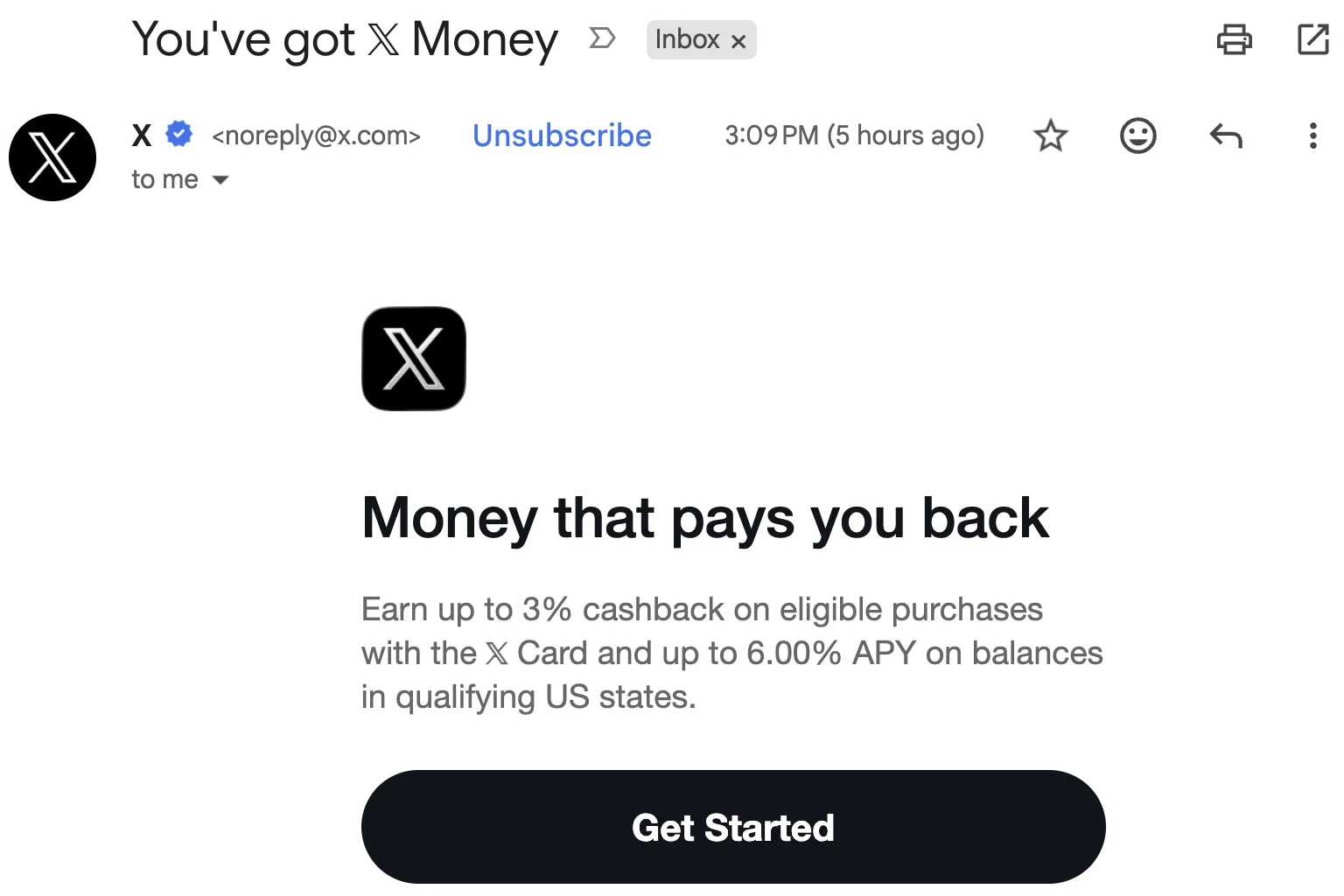
X Money is the financial service from X (formerly Twitter): a deposit account, P2P transfers, and a Visa debit card, with up to 6% APY and up to 3% cash back on the debit card. It opened first to paid X Premium subscribers, but around September 23, 2026 it dropped the subscription requirement, so a free account can open it too. That is why even free accounts received the “You’ve got 𝕏 Money” promo email. For now it is limited to US residents. Canadians, including readers here, can only watch.
X Money’s rules are still changing quickly. Before you open an account, go by the terms actually shown in the app.
What X Money is
In short, it is the finance piece of Musk’s “everything app” plan: a bank account, transfers, and a debit card inside the X social app, so you can hold money, send it, and spend it without leaving the app.
- Who runs it: X Payments LLC, a licensed money transmitter, not a chartered bank.
- Where the money sits: The underlying account is provided by partner bank Cross River Bank, and deposits are FDIC-insured through that bank. The FDIC nuance matters: the insurance covers a failure of Cross River Bank. If X Money itself fails and the bank behind it does not, the FDIC does not step in.
- Launch timeline: On July 27, 2026 it opened first to X Premium and Premium+ subscribers in the United States. Around September 23 it dropped the Premium requirement, so free accounts can open it too.
Features
| Feature | What it does |
|---|---|
| Deposit account | The balance earns interest, calculated daily and paid monthly |
| P2P transfers | Send money directly between X users. Your social graph is the contact list. Reports say Visa Direct makes standard transfers near-instant, and a standard transfer has no fee |
| X Card debit card | Not a credit card. It is a debit card on the Visa network: a virtual card plus an optional physical metal card, which can be engraved with your X handle. Apple Pay and Google Pay are supported |
| Direct deposit | Paychecks and similar deposits can land here, and reports say they can arrive up to two days before a normal payday |
| Other bank features | The official FAQ says it also supports wires, checks, debit-card transactions, and ATM withdrawals, among other things |
Interest: up to 6% APY, but it is tiered
This is X Money’s main selling point, but the rate is tiered, variable, and can change at any time:
| X subscription | Standard APY | How you reach 6% APY |
|---|---|---|
| Free / Basic | 4.00% | At least $1,000 in qualifying direct deposits (or X Creator income) in the past 34 days |
| Premium ($8 a month) | 4.00% | Same: a $1,000+ qualifying direct deposit |
| Premium+ ($40 a month) | 6.00% | You get it directly, with no direct-deposit requirement |
A few notes:
- A qualifying direct deposit means an ACH direct deposit (the kind with SEC code PPD), or certain X Creator income.
- New York residents are an exception. They currently earn no interest. New York rules required X to stop paying interest to NY residents from October 1. Instead there is a one-time $300 bonus: receive $3,000 in direct deposits within 90 days of opening the account.
- Opening bonuses: $25 for Premium+, $15 for Premium, and $5 for other accounts.
Debit cash back: up to 3%, with a long exclusion list
- Premium and Premium+ users: up to 3% cash back on eligible purchases.
- Free users: a standard 1%. A $1,000+ qualifying deposit in the past 34 days can raise that to 3%.
- Cash back posts automatically. Reports say it is credited to the account each week.
The exclusion list was expanded once in late September. New exclusions include utilities, wholesale clubs, jewelry and watch stores, insurance premiums, college tuition, and transactions with no MCC. Paying tuition or a utility bill through the card to “earn” the cash back is basically off the table.
This is the full excluded-MCC list from the official Cashback Rewards Terms. It was checked item by item against the official money.x.com page. Bold rows were added in late September:
| MCC | Category |
|---|---|
| 4829 | Wires and money orders |
| 4900 | Utilities |
| 5094 | Precious metals, gemstones, watches, and jewelry |
| 5300 | Wholesale clubs (Costco / Sam’s / BJ’s) |
| 5816 | Digital goods: games |
| 5944 | Jewelry stores and watch stores |
| 5972 | Stamp and coin stores |
| 6010 / 6011 / 6012 | Financial institutions (manual or automated cash disbursement, and goods and services) |
| 6051 | Foreign currency, money orders, and traveler’s checks |
| 6211 | Securities brokers |
| 6300 | Insurance premiums |
| 6513 | Real-estate rentals (rent) |
| 6532 | Payment transactions: customer financial institution |
| 6540 | Funds transfers |
| 7800 / 7801 / 7802 / 7994 / 7995 | Lotteries, casinos, and gambling |
| 8220 | College tuition |
| 9222 | Fines |
| 9311 | Taxes |
| 9399 | Government services |
| 9402 | Government postal services |
| 9406 | Non-US government lotteries |
| — | Transactions with no MCC |
Who can open an account (current rules)
- A US resident, and in a state where X is licensed. That is about 41 states today. New York pays no interest.
- Age 18 or older.
- An X account in good standing, with identity verification (KYC) and a verified US phone number.
An X Premium paid subscription was required— that requirement has been removed (around September 23, 2026).
In other words, the gate changed from a paywall to a nationality wall.
Can Canadians open one?
No. X Money is a US-only product for now. It needs a US residential address, a US phone number, and US identity verification. If you hold Canadian ID, Get Started in the email will most likely stop at the residence or KYC step. X has not announced any timeline for expanding outside the United States.
Risks and things to watch
- X is not a bank. X Payments LLC is a money transmitter. Deposit insurance depends on partner bank Cross River Bank. Tech Times has reported that the FDIC cited Cross River Bank twice for unsafe practices. That is context, not a conclusion.
- 6% is a customer-acquisition rate. It is well above the market. Around the same time, high-yield savings at US online banks were about 4–4.5%. This is most likely a subsidized cost of winning customers, and nobody knows how long it lasts. The rate is variable, and the company can change it at any time.
- The terms are still moving. From the July launch to dropping the subscription gate in September and expanding the cash-back exclusions, the rules changed several times in two months. Read the latest agreement in the app before you open an account.
- Do not mix this up with creator payouts. Creator programs such as X Original Content Rewards still require a Premium subscription. That is a separate gate.
A few traps in the account agreement (official terms)
The Stored Value Account Agreement published at money.x.com has a few clauses that are easy to miss. They matter more if you plan to keep a large balance there:
- Withdrawal limits can be cut at any time. The standard limit in the agreement is actually low. The higher customized limit shown in the app is not a long-term promise and can, in theory, be changed at any time. A few thousand dollars is not a big issue. If you put in $50,000 or $100,000, the liquidity risk on a large balance is real. A green light for deposits and a red light for withdrawals is the painful version.
- The sweep program is opaque. Funds may be swept to other FDIC banks to spread insurance coverage, but you cannot name a bank to exclude, and the daily allocation can change. You can request a breakdown of balances at each bank at most once a month, and the company has 15 business days to reply. You can opt out with written notice, but it is not a tap in the app.
- Withdrawals are not necessarily instant. After a sweep, a withdrawal “may take more than one business day.” If withdrawal demand is extreme, Cross River Bank reserves the right to process requests in the order received. That language leaves room for a delay when liquidity is tight.
- Wide discretion to freeze funds, and a $100 liability cap. The agreement allows X to delay or freeze funds for reasons such as reversals, chargebacks, and fees. The combined liability of Cross River Bank and X Payments is capped at $100. Even if they unreasonably hold $100,000 of yours for a month, consequential damages you can pursue are still limited by that $100 cap. Statutory consumer rights such as Regulation E are not waived.
- A 30-day opt-out from arbitration. The agreement binds you to arbitration by default and waives a jury trial and class actions. To reject that, you must mail a written notice within 30 days of accepting the agreement to the address it specifies, with your name, address, and SSN, and you must sign it. Most people will not notice this when they open the account, and the window is long gone by the time there is a problem.
Account security: do these before you open it
X Money ties a social account to money. Your X handle is now close to a bank-account number, and a stolen account goes from “I lost the handle” to “I lost the money.” After X Money rolled out widely in September 2026, there was a large wave of password-reset emails: attackers triggered X’s password-reset form in bulk to try to take over accounts. An X product engineer publicly said the company was investigating, and said it had not found evidence of a successful intrusion. Do these four things before you open an account:
- Turn on 2FA. Prefer an authenticator app, such as Google Authenticator or 1Password. Do not use SMS.
- Turn on X’s “Password reset protect.” That setting requires a phone or email check before a password reset can start, which blocks most bulk-triggered reset requests.
- Do not click links in password-reset emails. If you are unsure, open the X app and do it there. Do not follow the email.
- Do not use a public email address on the X account. Use an alias for important accounts, so an attacker cannot probe them in bulk from information that is already public.
Comments
Comments from a new email are reviewed before they appear.